
TEC News

TEC News

Opioid Use Disorder Law and Policy: Impacts on American Indians and Alaska Natives

TEC News, Training, Webinar

December 11, 2020
1 p.m. CNT

Topic:
Tribal Law & OUD

Description:
As the substance use disorder crisis continues to devastate communities across the United States, Tribal and American Indian communities are also impacted; yet insufficient attention has been paid to the law and policies perpetuating this crisis in Indian country. As sovereign nations, Tribes are uniquely situated to respond public health issues using their inherent sovereign authorities. Yet, issues related to federal Indian law and cross-jurisdictional issues between Tribes, states, and the federal government further complicate the implication of evidence-based legal interventions by Tribes or to support American Indian and Alaska Native communities. This webinar will explore Tribal, state, and federal substance use disorder law and policy and its impact in Indian country. It will focus on a variety of issues related to substance use disorder, with an emphasis on opioid use disorder.


Facilitated by the Great Lakes Inter-Tribal Epidemiology Center and presented by Aila Hoss, JD

Aila Hoss is public health attorney and an Assistant Professor at the University of Tulsa College of Law where she teaches and researches Indian law and health law. Prior to teaching, Professor Hoss practiced public health law as a staff attorney with the Centers for Disease Control and Prevention’s Public Health Law Program, where she worked to improve public health through the development of legal tools and the provision of legal technical assistance to state, Tribal, local, and territorial governments.

Register at: https://tinyurl.com/tribalopioid
View/Download Event Flyer (PDF 556 KB)
Intervention Research to Improve Native American Health (R01 Clinical Trial Optional)

Grant Opportunities, TEC News

The purpose of this funding opportunity announcement (FOA) is to support research on interventions to improve health in Native American (NA) populations. This includes 1) etiologic research, where there is a significant gap in knowledge, that will directly inform intervention development or adaptations, 2) research that develops, adapts, or tests the efficacy or effectiveness of health promotion and disease prevention interventions, 3) research that tests culturally informed treatment or recovery interventions and 4) where a sufficient body of knowledge on intervention efficacy exists, research on dissemination and implementation that develops and tests strategies to overcome barriers to the adoption, integration, scale-up, and sustainability of effective interventions.

Applications Due: May 17, 2021

View Grant Opportunity

Health Services Research on Minority Health and Health Disparities (R01- Clinical Trial Optional) Department of Health and Human Services National Institutes of Health

Grant Opportunities

The purpose of this Funding Opportunity Announcement (FOA) is to encourage innovative health services research that can directly and demonstrably contribute to the improvement of minority health and/or the reduction of health disparities at the health care system-level as well as within clinical settings.

Applications Due: March 27, 2023

View Grant Opportunity

Tribal Epidemiology Centers: Addressing COVID-19 in Indian Country

TEC News, Webinar

In this month’s Preventive Medicine Grand Rounds, speakers showcased the work of Tribal Epidemiology Centers (TECs) to protect American Indian and Alaskan Native persons against COVID-19. As Public Health Authorities, TECs are uniquely positioned within Tribal and Urban Indian communities to effectively conduct disease surveillance, public health research, prevention and control of disease, and more. This session highlights the importance of systematically including tribes, tribal organizations, and TECs into the United States public health system.

Authorized by Congress in 1996, TECs were established within the Indian Health Service (IHS) as a solution to the discontinuation of regional medical epidemiologist positions. Recognizing epidemiology as a major foundation of public health, several IHS staff who were graduates from CDC’s Preventive Medicine Residency and Epidemic Intelligence Service programs, worked together and served as the masterminds behind the formation of TECs. They were involved with guiding the concepts, developing the legislation that provides public health authority to the TECs today, and launching some of the first TECs.

Speakers

Captain Jennifer Giroux, MD, MPH
Public Health Advisor / Consultant
Great Plains Area Indian Health Service

Kevin English, DrPH
Director
Albuquerque Area Southwest Tribal Epidemiology Center

Aurimar Ayala, MPH
Epidemiology Manager
California Tribal Epidemiology Center

Amy Poel, MPH
Epidemiologist (stand-in for Adrian E. Dominguez)
Urban Indian Health Institute

Jonathan Davis, PhD
Program Manager
Inter Tribal Council of Arizona, Inc. Tribal Epidemiology Center

Pj Beaudry, MPH
Director
Great Plains Tribal Epidemiology Center


These grand rounds presentations are provided as a courtesy of CDC’s Preventive Medicine Residency and Fellowship program (PMR/F) with the goal of sharing systems-based approaches and leadership practices to address population health issues and public health emergencies.

Continuing Education

Continuing education (CE) is available and there is no cost for this activity. For more details, go to https://www.cdc.gov/prevmed/pmgr/continuing-education.html.

For More Information

Please contact the PMR/F program at prevmed@cdc.gov or visit the Preventive Medicine Grand Rounds web page.

Access the Webinar Recording here: https://adobeconnect.cdc.gov/pexm4j35o8jw/

View/Download the Event Flyer (PDF 144 KB)

View/Download Summary (PDF 381 KB)

COVID-19 Cases Spiking In State’s Indigenous Communities

TEC News, TECs in the Media
featured image

Wisconsin Public Radio

Coronavirus cases have tripled since the beginning of September among American Indians across Wisconsin as the state has witnessed a surge in new cases of COVID-19.

The Wisconsin Department of Health Services reported 2,374 cases of the virus among Native Americans on Thursday — that’s up from 775 cases on Sept. 1.

By Danielle Kaeding
October 23, 2020

Read Article

COVID-19 Cases Spiking In State's Indigenous Communities
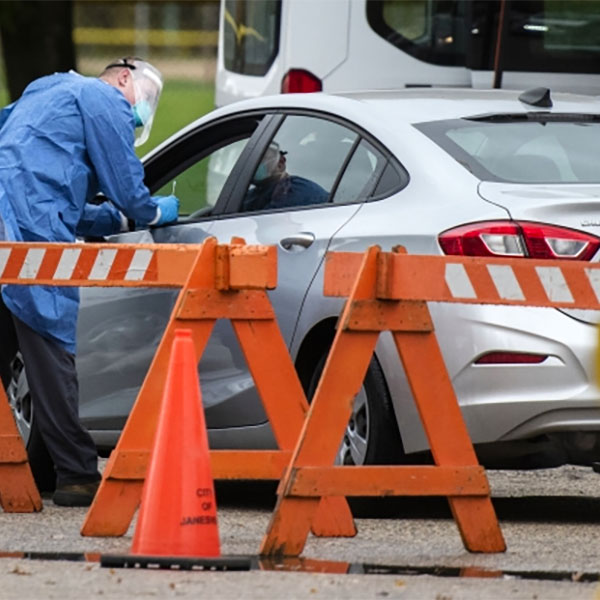
Photo: A COVID-19 test technician leans down to speak to a person in line before administering the test Monday, Oct. 12, 2020, in Janesville. Credit: Angela Major/WPR